The Conversation
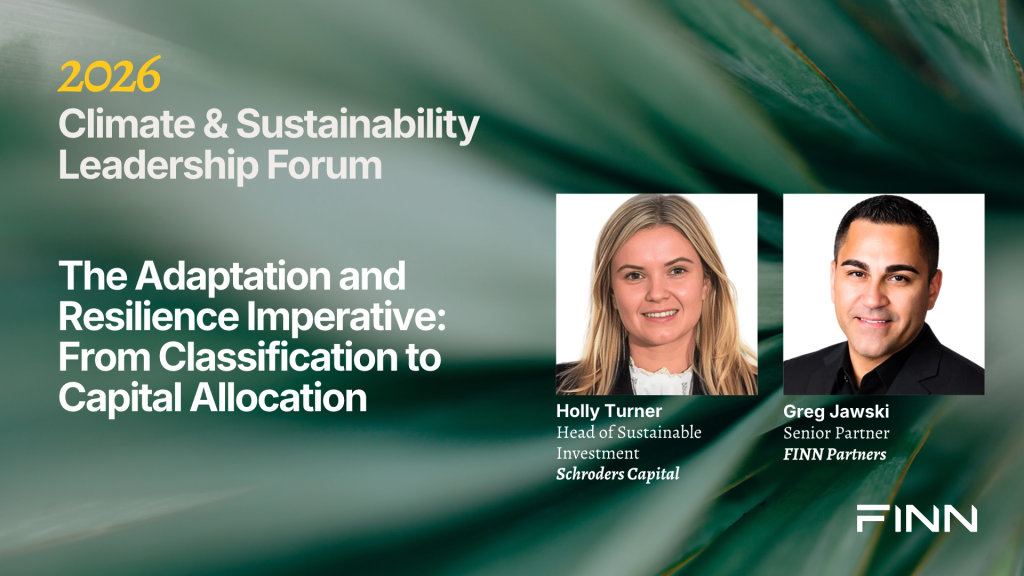
The Adaptation And Resilience Imperative: From Classification To Capital Allocation
Holly Turner in conversation with Greg Jawski
1BusinessWorld Editorial
Every investment in a building, a supply chain or a business carries an assumption about the conditions it will face. Climate adaptation asks leaders to make those assumptions explicit and direct capital toward assets, products and services that can keep working as those conditions change. The opportunity is to turn a clearer understanding of physical risk into practical protection, stronger businesses and lasting economic value.
That opportunity shaped the conversation between Holly Turner, Head of Sustainable Investment at Schroders Capital, and Greg Jawski, Senior Partner at FINN Partners, at the 2026 Climate & Sustainability Leadership Forum. Their conversation explored three questions that business leaders and investors need to answer. What protection does an investment provide? What is that protection worth? And what business model can sustain it?
Recognize The Adaptation Already Within The Business
Turner began with an observation that changes where leaders should look. Some adaptation investment already takes place without carrying an adaptation label. Businesses may improve infrastructure, strengthen buildings or invest in water systems because those choices make operational and financial sense. A narrow search for explicitly labeled projects can therefore miss activity that is already contributing to resilience.
Leaders can start with what a business needs to continue operating, then examine which investments strengthen that ability. Clear definitions help compare opportunities, but their value grows when they inform decisions about real assets and services. Schroders’ Climate Adaptation Investment Framework, developed in collaboration with CalPERS, connects the classification of activities with the questions investors need to answer.
Measure The Economic Value Of Protection
The framework evaluates 102 adaptation activities spanning infrastructure, technology, products and services. Its central measure compares the climate-related losses an activity could avoid with its costs. Turner explained that the cost assessment includes both implementation and ongoing expenditure, giving investors a more complete basis for comparison.
The Schroders research announcement reports that 95 activities were modeled to prevent economic losses equal to or greater than their costs. The model estimated a median of $3.10 in avoided losses for every $1 of cost. These are modeled economic benefits, with outcomes dependent on the circumstances and assumptions behind each activity.
Turner highlighted early warning systems, seawalls, storm-resistant construction and heat-health warning measures among the stronger results. She also identified an important measurement challenge. A specific intervention can be easier to evaluate than resilience created through several organizations working together. Leaders should examine what a measure captures before using its ranking to set priorities.
Connect Economic Benefit With A Durable Business Model
The conversation’s central distinction concerned who receives the value. An activity can protect communities and economic activity while offering a less obvious route to revenue for a private investor. Turner explained that many high-benefit activities are public goods. A seawall, for example, can protect multiple businesses and households across an area, spreading its benefits well beyond a single owner.
Alongside the economic case, investors need to establish how an investment can earn a return. Turner described climate analytics, insurance-linked securities, catastrophe bonds and certain hazard-specific technologies as areas whose investment characteristics can differ from their position in the avoided-loss rankings. The framework separates these questions so that each can be examined on its own terms.
For leaders preparing a proposal, that distinction sharpens the work. Specify the protection being delivered, identify its beneficiaries and explain the source of recurring revenue or financial value. A credible funding case makes each connection visible.
Build Decisions Around Local Conditions
Adaptation is inherently local. Turner emphasized that a global framework provides a starting point for comparison, while individual decisions depend on the hazards affecting a particular place. An activity may address several risks or one highly specific threat. Its relevance also depends on when those risks are likely to emerge.
Risks already being experienced can influence customer demand and public priorities today. Other needs may become clearer as conditions change. This makes timing part of the investment case. Leaders need to consider current exposure, the period an asset will remain in use and the assumptions underpinning future demand. A common framework becomes most useful when teams bring it into contact with those operating realities.
Apply Resilience Across Investment And Ownership
Turner described three applications for the research. Investors can use it to assess climate solutions, manage portfolio risk and engage with companies. Together, they place adaptation within the core responsibilities of investors and business owners.
In climate solutions, the opportunity includes strengthening a company’s own resilience, financing businesses that provide adaptation products and services, supporting systems that benefit several stakeholders and providing financial mechanisms to transfer risk. These activities serve different purposes and can require different forms of capital.
At portfolio level, Turner pointed to the need to understand concentrations of exposure to particular hazards or vulnerable locations. Diversification and risk management decisions depend on seeing those connections across investments. In ownership and engagement, the framework can help prioritize adaptation actions and support more concrete conversations about a company’s plans, resilience expenditure and capital allocation.
Make Resilience A Standard Of Leadership
Jawski closed by asking whether today’s investments are preparing businesses for the resilience they will need tomorrow. Turner’s analysis gives that question a practical structure. Leaders can examine the risk, compare the protective value of available responses and establish where a sound financial case exists.
Each investment should have a clear purpose, a sound economic case and evidence that reflects the conditions it will face. By bringing those disciplines together, businesses and investors can direct capital toward solutions that protect activity, support communities and create the conditions for durable growth.
Watch The Adaptation And Resilience Imperative: From Classification To Capital Allocation, featuring Holly Turner and Greg Jawski.