The energy transition reaches into the ordinary decisions through which a business builds its future. A new production line, a building upgrade, a software purchase, or a supplier contract can influence energy use for years. Each decision has its own owner and budget. The opportunity for leadership is to see what those decisions can accomplish together.
Electrification changes how a business powers its activities. Digitalization makes energy use more visible and manageable. Connecting them changes the investment question. Alongside the cost and capacity of new equipment, leaders can consider how it will be controlled, how its performance will be measured, and how it can remain useful for longer. Sustainability becomes part of the reasoning behind a purchase and the work that follows it.
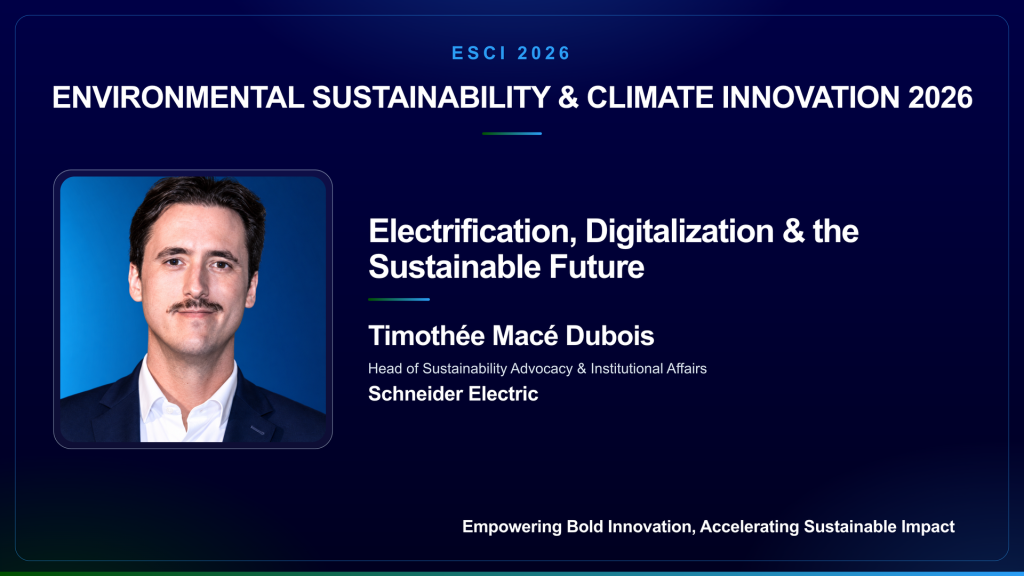
That connection runs through Electrification, Digitalization & The Sustainable Future, the ESCI 2026 Environmental Sustainability & Climate Innovation session by Timothée Macé Dubois, Global Head of Sustainability Advocacy & Institutional Affairs at Schneider Electric. The accompanying presentation describes an energy transition built through product design, operating decisions, supplier relationships, and education. Its strongest business lesson is the relationship among those activities.
A Better Energy Decision Starts Before Equipment Is Installed
Schneider Electric describes electrification technologies that support clean energy use, grid resilience, efficient power conversion, and storage. Alongside them, it places digital monitoring, data acquisition, analytics, and process control. The relationship matters because a business needs both the means to change its energy use and the means to understand what that change delivers.
This gives digital investment a specific job. Information about energy consumption can inform the way a physical system is operated. Process controls can put that information to use. A company considering an electrical upgrade can therefore examine the equipment and its controls together, with a clear view of the operating performance it wants to achieve.
Schneider Electric’s own sites illustrate the value of treating efficiency as continuing work. Its presentation traces an energy action program back to 2005, followed by energy-management certification and successive cycles of efficiency improvement. For the 2021–2025 cycle, the company reports a 17.4% improvement in energy efficiency against the previous sustainability cycle. The significance is the continuity of the effort. Measurement and improvement remain relevant after the equipment has been installed and the initial project budget has closed.
For executives, this changes what it means to finish an energy investment. Installation is one milestone. The ability to understand and improve performance over the asset’s life is another source of value, deserving attention when the investment is approved.
The Purchase Price Is Only Part Of The Design Decision
The same reasoning applies to the resources embodied in a product. Schneider Electric’s presentation describes an approach to design that emphasizes better material use, longer service life, and reuse. Its circular services include remanufacturing, maintenance optimization, and services intended to extend asset life.
These choices connect engineering with the customer’s experience of ownership. A product designed to be serviced has a different future from one whose usefulness ends when a component fails. Environmental information can help a purchaser understand material and lifecycle considerations, while maintenance and reuse affect the options available later.
The deck traces Schneider Electric’s work on product environmental data from lifecycle analysis in the 1990s to the integration of component and material supplier data into product development. Its stated 2030 design ambition covers all major offers in the design phase and brings circularity, serviceability, resilience, and decarbonization into that work.
The implication for business leaders is concrete. Decisions about product value should account for what happens during ownership as well as at purchase. Bringing maintenance, engineering, and procurement into that discussion can reveal requirements that a purchase-price comparison alone would miss. Design then becomes a way to preserve future choices for both the business and its customers.
Supplier Progress Begins With A Shared Task
A company’s ability to improve its own operations gives it useful experience to bring to supplier relationships. Schneider Electric reports an 82% reduction in its Scope 1 and 2 operational CO2 emissions between 2017 and 2025. Separately, it reports a 56% reduction in operational CO2 emissions from its top 1,000 suppliers during 2021–2025. The figures describe different boundaries and periods, but together they show why the company gives attention to both its own activities and its supply base.
Its next ambition expands the supplier effort. By 2030, Schneider Electric aims to engage 1,500 suppliers on a Zero Carbon Pathway. The presentation describes engagement extending across suppliers’ Scope 1, 2, and 3 emissions, alongside work on product carbon footprints.
This places procurement close to the technical work of decarbonization. A supplier relationship can support better information about a product, discussion of lower-carbon materials, and a clearer understanding of where changes are possible. The company’s supplier agenda also includes responsible recruitment, living wages, and workforce development through its Decent Work program.
For leadership, the opportunity is to give commercial relationships enough depth to support improvement. Expectations need to be understood by the people selecting materials, designing products, and managing operations. Shared work on those decisions can carry an environmental objective much further than a statement of intent in a contract.
Skills Determine What Technology Can Deliver
The people who install, operate, and maintain energy systems are central to the transition. Schneider Electric reports that more than one million people had been trained in energy management by 2025 through an effort spanning more than 60 countries and more than 400 partners. Its presentation describes training relationships with nongovernmental organizations, education partners, and local authorities.
Training helps connect an investment in technology with the people who will operate and maintain it. A business can invest in new equipment and software while also investing in the knowledge needed to use them well. Education broadens the group of people able to take part in the transition and gives technical investment a stronger basis for lasting use.
The next stage of the energy transition will be shaped by these everyday business decisions. Businesses can make energy performance visible, design assets for longer use, deepen technical collaboration with suppliers, and develop the people who carry those decisions into practice. Electrification and digitalization make new possibilities available. Leadership gives those possibilities a place in the decisions a company makes every day, and in the value those decisions create over time.